 biblegram


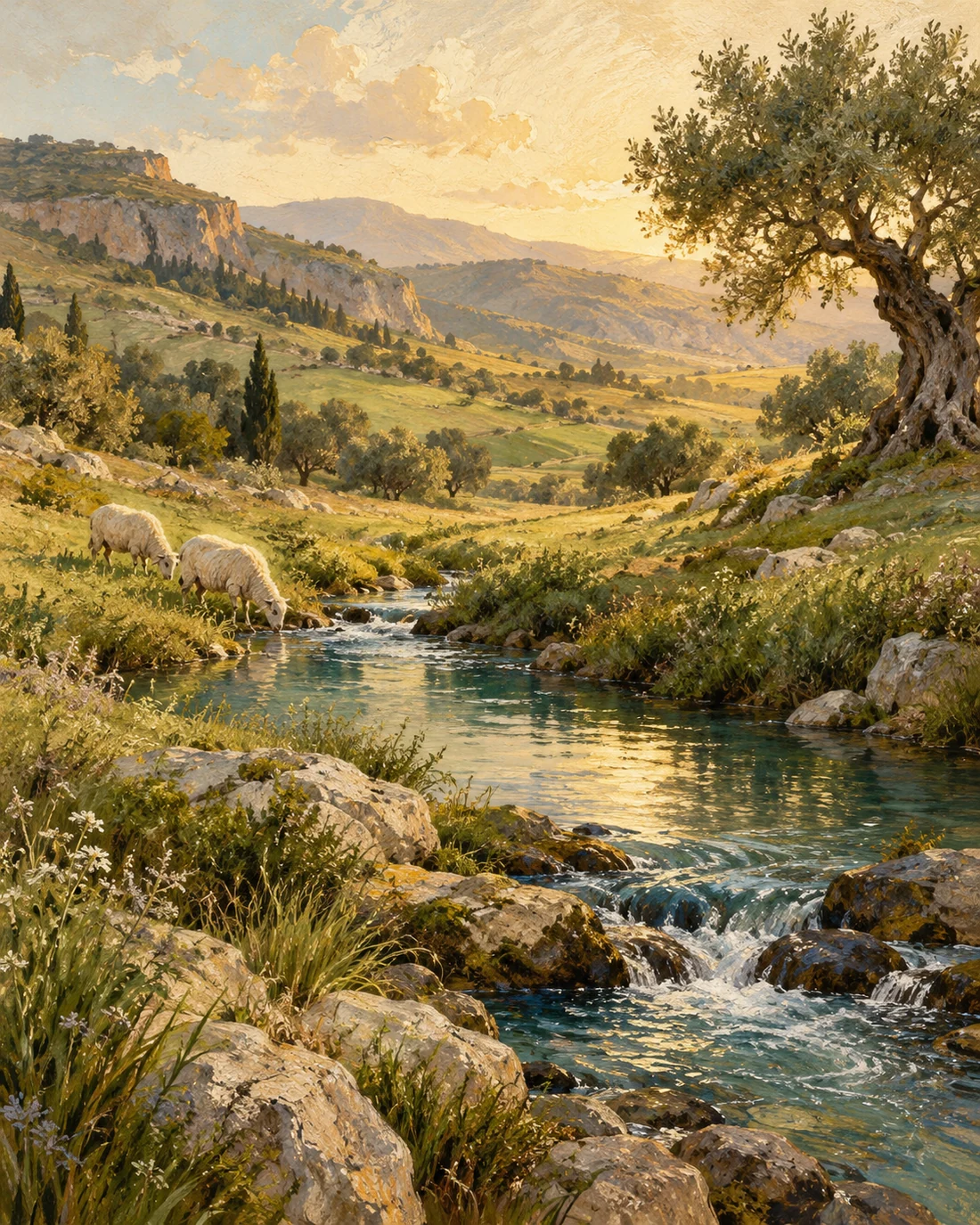
This reading guide follows the six verses, then offers questions for personal or group study. The explanation is commentary; the scripture text appears separately below.
Read Psalm 23 in the World English Bible
1 Yahweh is my shepherd: I shall lack nothing.
2 He makes me lie down in green pastures. He leads me beside still waters.
3 He restores my soul. He guides me in the paths of righteousness for his name’s sake.
4 Even though I walk through the valley of the shadow of death, I will fear no evil, for you are with me. Your rod and your staff, they comfort me.
5 You prepare a table before me in the presence of my enemies. You anoint my head with oil. My cup runs over.
6 Surely goodness and loving kindness shall follow me all the days of my life, and I will dwell in Yahweh’s house forever.
World English Bible, Classic text. Its use of “Yahweh” differs from WEB editions that use “LORD.” Read the source passage or compare the WEB and KJV reading guide.
Verse 1: the shepherd and the speaker’s need
The psalm opens with a relationship: God is the speaker’s shepherd. The declaration about lacking nothing belongs to that picture of dependence and care. The rest of the poem matters when interpreting it. Verse 4 still contains danger, and verse 5 still contains enemies. The opening is not a blank cheque for every desire or a claim that faithful people never experience loss.
A useful first question is what a shepherd contributes to the picture. Guidance, nourishment, and protection emerge in the following lines. Let the poem develop its own image before turning it into an application.
Verses 2–3: rest, restoration, and a path
Green pastures and still waters give the poem a landscape of provision. The movement continues into restoration and guidance. Rest is not the only image: the speaker is also led along a path described in moral terms, the paths of righteousness.
When reading, notice the verbs assigned to the shepherd. The speaker receives care and direction rather than describing a route of self-sufficiency. A reflection might therefore ask what it means to receive help or guidance, while remembering that this is an application of the poem, not a new sentence within it.
Verse 4: the valley and the change in address
The valley does not disappear from the poem. Instead, the speaker addresses God directly. The earlier lines speak about what “he” does; here the voice says “you.” That change brings the relationship close at the point of danger.
The rod and staff belong to the shepherd imagery and are described as comforting. The verse grounds the speaker’s confidence in presence, not in a statement that there is nothing to fear in the world. For a careful study, underline the reason the speaker gives rather than supplying a reason from outside the text.
Verse 5: a table in the presence of enemies
The scene shifts from a journey to a prepared table. Oil and an overflowing cup extend the picture of welcome and generous provision. The enemies remain part of the setting; the speaker is received in their presence.
This change of imagery matters. A painting of sheep in a green field may help you notice the first part of Psalm 23, but it cannot show everything the poem says. The table draws attention to hospitality as well as protection. Read both pictures rather than reducing the whole psalm to a peaceful landscape.
Verse 6: goodness, loving kindness, and dwelling
The final verse looks across the speaker’s life and toward dwelling in God’s house. It ends with belonging and continuing relationship. Readers from different traditions may explore its final phrase in different ways, but the direction of the poem is clear: the speaker’s confidence rests in the God addressed throughout it.
The conclusion is larger than a pleasant moment. Its language brings the journey, provision, and welcome into a sustained expression of trust. Read it again alongside the opening and notice how the final image gives the first declaration more depth.
Psalm 23 Bible study questions
- Which verbs describe God’s action in verses 1–3?
- Where does the speaker move from talking about God to addressing God?
- Which difficulties remain present in the poem?
- How does the table image add to the shepherd image?
- What would be lost if you read only the first verse?
- Which line would you like to return to, and what does its context help you understand?
A reflection that stays close to the passage
Try making two short notes: one about what the psalm says, and one about your response. For the first, describe a detail you can locate in a verse. For the second, name a question, a reason for gratitude, or a prayer. Keeping them distinct allows your response to be personal without turning it into a claim about the poem’s exact wording.
If you are using the pasture artwork above this guide, ask which parts are artistic choices and which are anchored in the text. Our guide to visual Bible study offers a simple way to make that distinction.