 biblegram


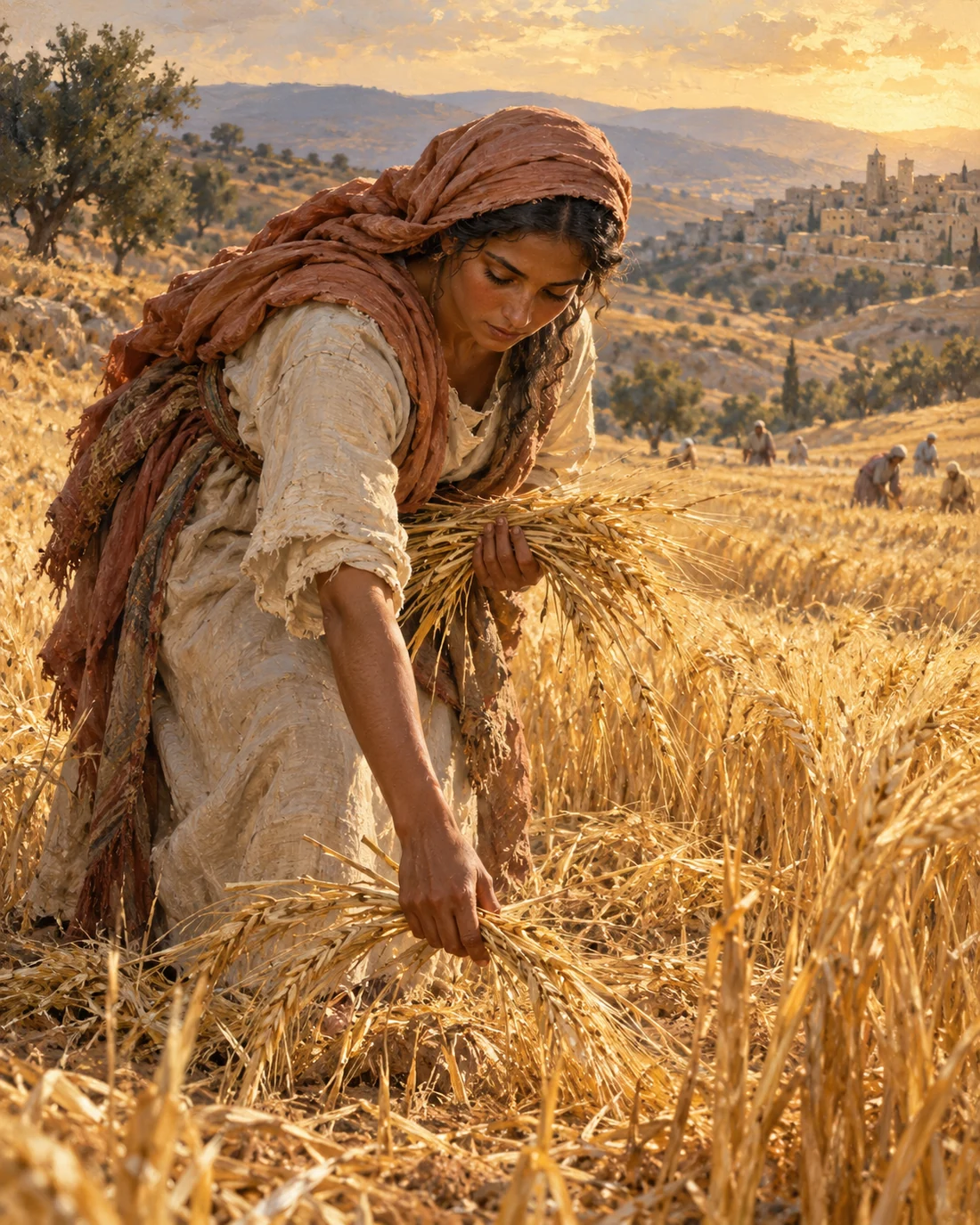
Read Ruth 1 before beginning if the story is new to you. Ruth and Naomi arrive in Bethlehem after bereavement and a journey from Moab. Chapter 2 then narrows its attention to a working day in a field and the conversation when Ruth returns home.
Ruth chapter 2 summary
Ruth asks Naomi to let her go and glean. She comes to a field belonging to Boaz, a relative of Naomi’s late husband. Boaz learns who she is and invites her to remain with his workers. He gives instructions for her safety, offers water and food, and tells the workers to leave additional grain for her.
Ruth brings the gleaned barley and leftover food back to Naomi. When Naomi learns whose field it was, she identifies Boaz as a close relative. The chapter ends with Ruth continuing to glean through the barley and wheat harvests while living with Naomi. The day opens a possibility in the story; it does not resolve everything immediately.
What is gleaning, and why was Ruth doing it?
Gleaning means gathering what remains after a harvest is reaped. In this chapter, Ruth gathers grain after the workers. Leviticus 19:9–10 instructs Israelite landowners not to take the entire harvest for themselves, leaving gleanings for people in poverty and for foreigners. That background helps explain why a field could become a place to seek food.
Ruth’s work is not a decorative detail. She proposes going out, continues working, beats out what she gathers, and brings it home. At the same time, effort alone does not explain the chapter. The landowner’s decisions about access, treatment, and additional provision shape what the working day becomes.
Who is Boaz in Ruth 2?
The narrator introduces Boaz as a man of wealth from the family of Elimelech, Naomi’s late husband. Naomi later identifies him as a close relative. Those details connect the field scene to the family story without requiring a first-time reader to know the ending.
Notice how the chapter introduces his character through speech and action. He greets the workers, asks about Ruth, addresses her, and instructs the people under his authority. His kindness is not only a private attitude. It changes the conditions in which someone else works.
How does Boaz show kindness to Ruth?
- A place to remain: he tells her to stay near his women workers rather than seek another field.
- Protection: he says he has instructed the young men not to touch her.
- Water: she may drink from the vessels filled by the workers.
- A meal: she is invited to eat, is satisfied, and has food left over.
- Additional grain: he tells the workers to leave some from the bundles and not rebuke her.
These details help prevent a vague reading of the chapter as merely “be nice.” The care is practical and involves the use of authority and resources. A study question worth asking is which actions Ruth can see directly and which instructions the reader hears Boaz give to the workers.
What does the image of refuge under God’s wings mean here?
In verse 12, Boaz speaks of Ruth seeking refuge under the wings of the God of Israel. The image is a blessing spoken to a woman whose journey and care for Naomi he has heard about. Read it alongside the acts of provision in the scene rather than detaching it into a separate prediction.
It is reasonable to reflect on how human actions can express care. It is less careful to turn the chapter into a formula in which hard work guarantees wealth, a particular relationship, or a quick resolution. The story gives us specific people, losses, choices, and circumstances.
What changes when Ruth returns to Naomi?
The return scene includes more than an amount of grain. Ruth shares food and tells Naomi where she worked. Naomi responds with blessing and identifies the family connection. The reader sees a conversation begin to look forward, while the chapter still ends with ordinary work and a shared household.
A close reading can hold both things together: the day has brought real provision, and the larger situation is still unfolding. You do not need to erase the women’s losses to notice the kindness they receive.
Ruth 2 Bible study questions
- What does Ruth initiate, and what does she receive from other people?
- Which details show the physical work of gleaning?
- How does Boaz’s authority affect the way Ruth is treated?
- What does the meal add to the story beyond access to grain?
- What does Naomi know at the end of the day that she did not know at its beginning?
- Which practical act of care could you consider without making yourself a direct equivalent of one of the characters?
Reading the field artwork carefully
The artwork accompanying this guide is an original Biblegram interpretation. It can draw your attention to grain, work, and the scale of the field. It cannot establish Ruth’s exact appearance, the weather, or a feeling the text does not name. Return to the chapter after looking at it and label your observations accordingly.
For a method you can use with another image, continue to visual Bible study. For a simple structure for your notes, use the beginner study guide.